INTRODUCTION
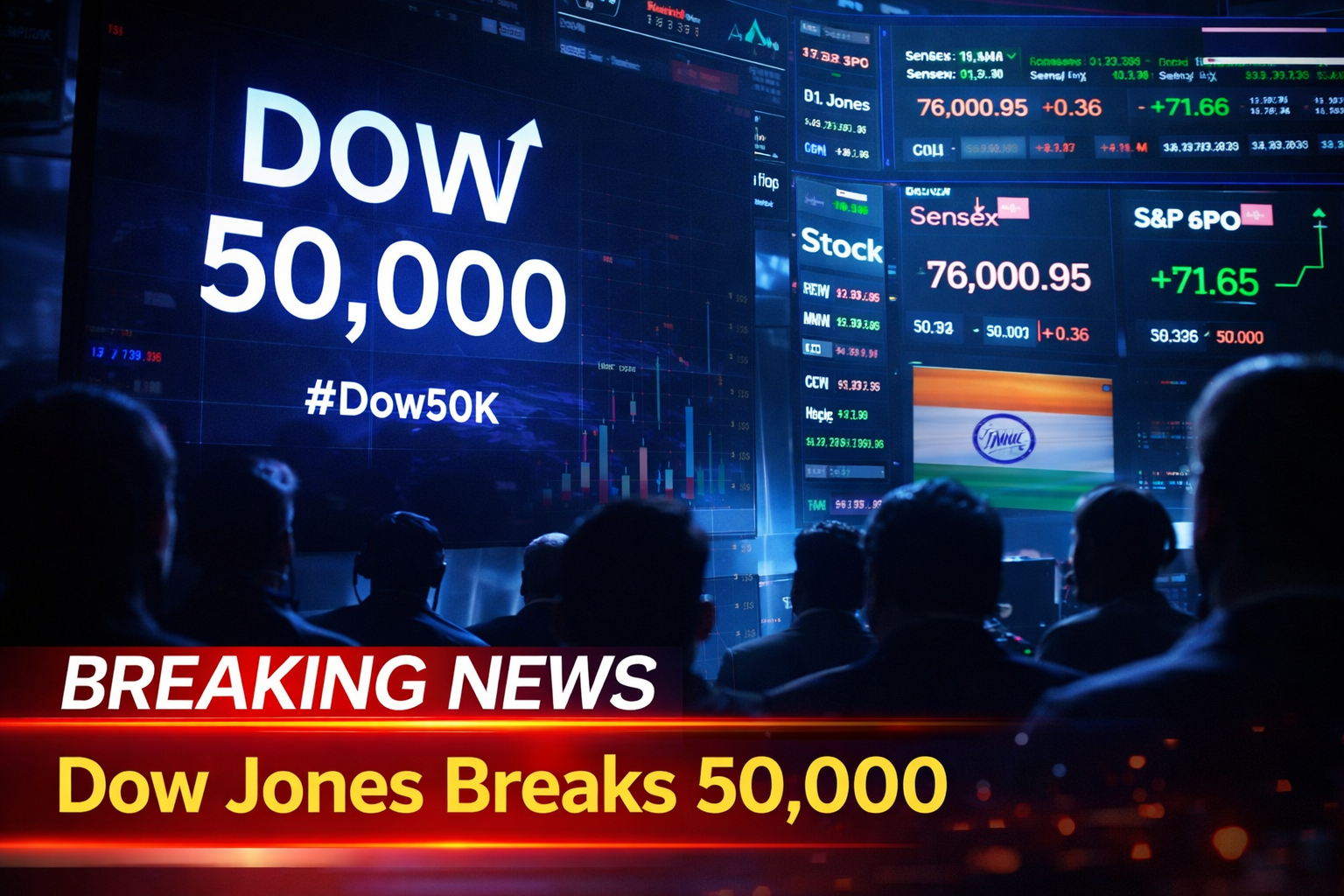
In a historic moment for global financial markets, the Dow Jones Industrial Average breaks past the 50,000 mark for the first time ever. The psychological milestone has electrified Wall Street and drawn attention across the world, including India, where investors closely track US market trends
The move is not just symbolic. The Dow Jones Industrial Average breaks through 50,000 at a time when global markets are reassessing growth prospects, inflation signals, corporate earnings strength, and interest rate expectations. For Indian investors, fund managers, and policymakers, this development carries deeper implications beyond the headlines
This milestone reflects confidence in the US economy, strong corporate performance, and broad-based participation beyond just technology stocks. It also raises important questions: Is this rally sustainable? Could it influence capital flows into emerging markets like India? And what risks remain under the surface?
Let us break down what is happening and why it matters
What Is Happening
The Dow Jones Industrial Average, which tracks 30 large and influential US companies, surged past 50,000 during recent trading sessions. The index, often seen as a barometer of American corporate health, has steadily climbed over the past year amid resilient economic growth and strong quarterly earnings
According to official data released by the US Bureau of Economic Analysis, the American economy has shown steady expansion supported by consumer spending and business investment. Meanwhile, corporate earnings reports across sectors such as industrials, energy financials, and manufacturing have outperformed analyst expectations in recent quarters
Market strategists note that this rally has not been limited to technology giants alone. Traditional sectors such as construction equipment, aerospace, financial services, and consumer brands have also contributed significantly This broader participation suggests structural strength rather than a narrow, speculative surge
The Dow’s rise also comes amid expectations that the US Federal Reserve may adopt a more balanced monetary stance if inflation continues to moderate. Lower borrowing costs or stable interest rate conditions tend to boost equity markets, as they reduce corporate financing pressure and increase investor appetite for risk
In global financial circles, when the Dow Jones Industrial Average breaks a major level like 50,000, it signals investor optimism about economic durability. However experienced market watchers caution that milestones often come with volatility

Key Data and Statistics
Here is a snapshot of recent US market performance
| Indicator | Latest Level | Year-to-Date Change | 1-Year Change |
|---|---|---|---|
| Dow Jones Industrial Average | 50,115.67 | +4.3% | +16% approx |
| S&P 500 | 5,400+ | +5% approx | +18% approx |
| Nasdaq Composite | 16,000+ | +3% approx | +20% approx |
| US GDP Growth | Around 2%+ | Stable | Moderate growth |
| US Inflation (CPI) | Below peak levels | Cooling trend | Lower than previous year |
The Dow gained over 1,200 points in a single session during the breakout, marking one of its strongest daily advances in recent months
In simple terms, this means investors are not just betting on future growth they are reacting to visible improvements in earnings, economic stability, and corporate performance
Historically, when the Dow Jones Industrial Average breaks a significant psychological level it often leads to increased global fund flows and short-term momentum trading
Why This Matters for India
For Indian readers, the question is obvious: Why should we care when the Dow Jones Industrial Average breaks 50,000?
The answer lies in global financial interconnectedness
Foreign Institutional Investors
US market performance influences risk appetite globally. When Wall Street performs strongly, global funds often increase allocations to equities worldwide, including India. Positive US sentiment can boost inflows into Indian equities
Rupee and Dollar Movement
A strong US economy can strengthen the dollar. A stronger dollar sometimes pressures emerging market currencies, including the rupee. This can impact import costs and inflation dynamics in India
IT and Export-Oriented Companies
Indian IT companies derive a significant portion of revenue from the US. Strong American corporate spending often translates into higher technology outsourcing and consulting budgets
Commodity and Oil Trends
US economic strength can push global commodity demand higher For India, which imports crude oil, this can influence trade balance and inflation
Indian Market Sentiment
Historically, Indian benchmark indices like Sensex and Nifty often react to major Wall Street milestones. When the Dow Jones Industrial Average breaks a new high, it can create positive momentum in Asian markets during early trade
In short, this is not just an American headline. It has direct and indirect effects on Indian markets, businesses, and investors
Industry and Expert Perspective
Market research reports from major global investment banks suggest that the current rally reflects confidence in corporate profitability rather than excessive speculation. Analysts point to improved balance sheets, stable employment data, and controlled inflation trends as supporting factors
According to commentary from Federal Reserve officials in recent policy briefings, monetary decisions remain data-dependent. While interest rates have been elevated to control inflation there are signals that policymakers are monitoring economic resilience carefully
Indian brokerage houses have also observed that a broad-based US rally could help sustain global equity optimism in the near term
Financial analysts emphasize that while the Dow Jones Industrial Average breaks a symbolic number, valuation metrics must still be examined. Price-to-earnings ratios in certain sectors remain elevated compared to long-term averages
Institutional investors generally focus more on earnings growth sustainability than headline levels. That is why quarterly earnings guidance and macroeconomic data will remain critical in determining whether this breakout holds
Challenges and Risks
Despite the celebratory mood several risks remain
Inflation Concerns
If US inflation resurges, the Federal Reserve may be forced to maintain or even raise interest rates, which could dampen equity momentum
Geopolitical Uncertainty
Ongoing geopolitical tensions in different regions continue to create supply chain risks and energy market volatility
Valuation Stretch
After sustained rallies, certain sectors can become overvalued. If earnings growth slows, markets may correct sharply
Debt and Fiscal Deficit
The US fiscal deficit and rising debt levels remain long-term structural concerns. Higher government borrowing can influence bond yields and market stability
History shows that when the Dow Jones Industrial Average breaks a psychological level, short-term euphoria can sometimes give way to volatility
Balanced analysis is essential
What Happens Next
In the short term, global investors will closely monitor upcoming US inflation data, employment figures, and corporate earnings reports
If economic indicators remain stable and inflation continues moderating, equity markets could extend gains. However, any negative surprise may trigger profit booking
In the medium term, structural themes such as artificial intelligence, industrial reshoring, green energy investment, and digital transformation are likely to shape market direction
For India, sustained US economic growth could mean stronger export demand, improved global liquidity conditions, and supportive investor sentiment
However, policymakers in India will also watch currency stability, oil prices, and global capital flows carefully
The bigger question is not just whether the Dow Jones Industrial Average breaks new highs, but whether earnings growth can justify valuations over the next 12 to 24 months
FAQs
What does it mean when the Dow Jones Industrial Average breaks 50,000?
It means the index crossed the 50,000-point level for the first time, marking a historic milestone for US equities
Does this impact Indian stock markets?
Yes. Strong US markets often influence global sentiment and foreign investment flows into India
Is this rally driven only by tech stocks?
Recent gains show broader participation, including industrial and financial companies
Could the market correct after this milestone?
Yes. Markets can face volatility due to inflation data, interest rate decisions, or geopolitical risks
Should Indian investors change strategy?
Investment decisions should align with personal financial goals and risk tolerance. Global trends are important but not the only factor
CONCLUSION
The moment the Dow Jones Industrial Average breaks the 50,000 level will be remembered as a symbolic turning point in global financial history It reflects confidence in corporate strength and economic resilience in the United States
For India, this development carries implications for capital flows, export demand, currency trends, and overall market sentiment
However, milestones are not endpoints They are checkpoints in an ongoing economic journey. As global markets evolve sustainability of earnings, monetary policy clarity, and geopolitical stability will determine whether this rally marks the beginning of a new phase or simply a powerful moment in a longer cycle
The Dow Jones Industrial Average breaks a psychological barrier, but the real story lies in what happens next