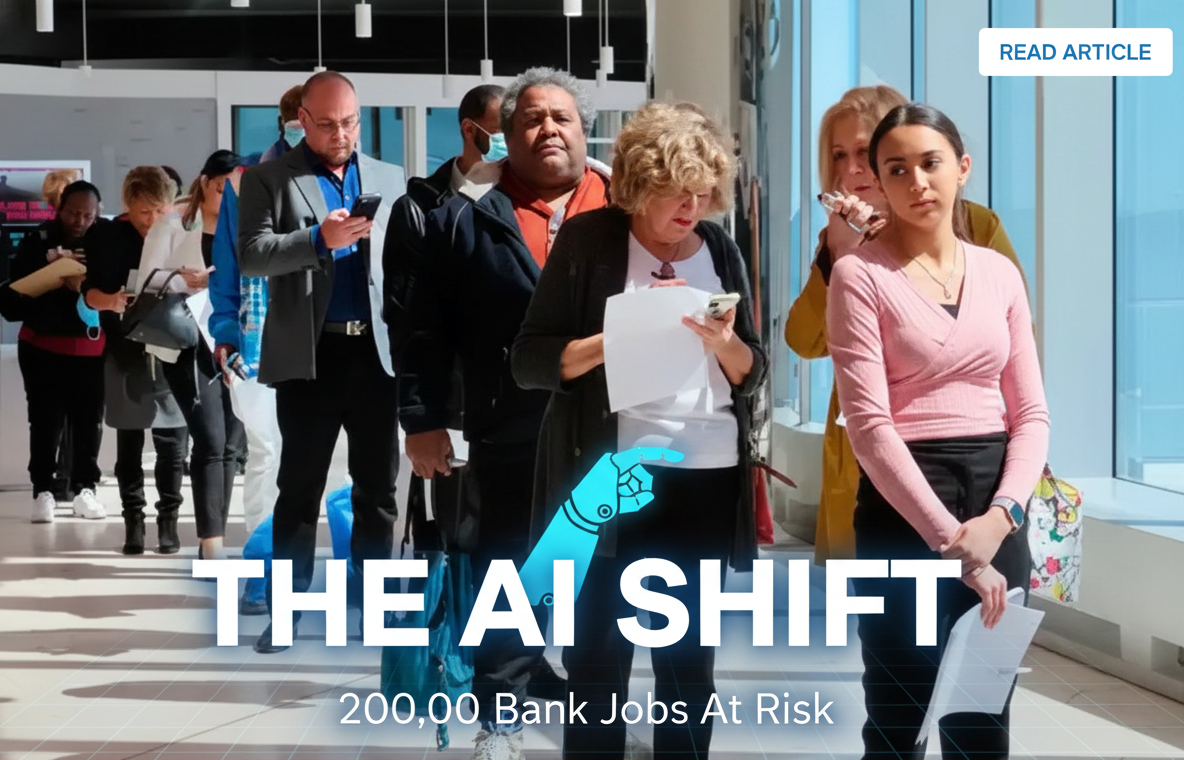
The global job market is entering a new and uncomfortable phase After shaking the technology sector with unprecedented layoffs artificial intelligence is now knocking on the doors of banking A recent warning linked to Morgan Stanley has sparked concern worldwide suggesting that 200000 bank jobs could disappear in the coming years as automation and AI driven systems rapidly replace traditional roles
This is not speculation or fearmongering It is a structural shift powered by cost pressure digital transformation and machine intelligence that does not sleep complain or demand salaries For millions of banking professionals across Europe and beyond the message is clear change is no longer coming it is already here
This article breaks down what is happening why it matters which jobs are most at risk and what the future of banking employment may look like in an AI first world
Why Banking Is the Next AI Target
Banking has always been about numbers processes and risk management which makes it highly compatible with automation Unlike creative or physical jobs many banking functions are repetitive rule based and data heavy
AI systems today can
- Process loan applications in seconds
- Detect fraud with higher accuracy than humans
- Handle customer service through chat and voice bots
- Automate compliance reporting and audits
- Analyze markets and portfolios at scale
These capabilities make AI not just an assistant but a replacement for many traditional roles
According to industry analysts the sector is under pressure to cut costs while maintaining profitability. AI offers a tempting solution

Morgan Stanley Warning Explained
A report referenced by Morgan Stanley suggests that over the next five years more than 200000 bank jobs in Europe alone could be eliminated due to digitalisation and artificial intelligence
The estimate is based on
- Current adoption rates of AI tools
- Cost reduction targets of major banks
- Declining need for physical branches
- Increasing customer shift to digital banking
The warning does not mean banks are collapsing It means banks are evolving faster than their workforce can adapt
Roles Most at Risk in Banking
Not every banking job will disappear but many will be reshaped or reduced The most vulnerable roles share common characteristics they are repetitive transactional and rules driven
High Risk Banking Roles
- Data entry and back office operations
- Clerical and administrative staff
- Call center and customer support agents
- Junior analysts doing manual reporting
- Basic compliance monitoring roles
Moderately Affected Roles
- Relationship managers
- Credit analysts
- Branch managers
- Operations supervisors
Low Risk and Growing Roles
- AI governance and ethics officers
- Cybersecurity specialists
- Risk strategists
- Product innovation managers
- Human relationship focused advisors
How AI Is Cutting Costs for Banks
The financial incentive behind automation is massive One AI system can replace hundreds of employees while improving speed and accuracy
Key Cost Advantages of AI
- No salaries or benefits
- 24 by 7 availability
- Reduced error rates
- Faster decision making
- Scalable operations across regions
This explains why executives see AI as a competitive necessity rather than a choice
Trump Administration Approved Major Lithium Mine — Top Official’s Husband Made Millions
Table Banking Jobs and AI Impact
| Banking Function | AI Impact Level | Job Outlook |
| Customer Support | Very High | Sharp decline |
| Back Office Ops | Very High | Major automation |
| Risk Analysis | Medium | Role transformation |
| Wealth Advisory | Low | Human led growth |
| Cybersecurity | Low | Strong demand |
Lessons from Tech Industry Layoffs
The technology sector experienced mass layoffs before banking because it was the first to integrate AI deeply into workflows What happened there offers a clear warning
Key patterns observed
- AI replaced junior and mid level roles first
- Productivity increased with smaller teams
- Hiring resumed only for highly skilled roles
- Generalists were replaced by specialists
Banking is now following the same trajectory
Global Impact Beyond Europe
While the estimate focuses on Europe the trend is global. Banks in the US Asia and emerging markets are investing heavily in AI driven systems
In countries like India and Southeast Asia where banking employment is large the long term impact could be even more disruptive due to scale
Global banks operate on shared platforms which means once automation is deployed it spreads quickly across regions
What Banking Professionals Should Do Now
The disappearance of 200000 bank jobs does not mean 200000 people become unemployable It means skills must evolve
Smart Career Adaptation Steps
- Learn AI basics and data literacy
- Shift from operations to strategy roles
- Develop client relationship and advisory skills
- Upskill in compliance technology and risk modeling
- Embrace hybrid roles combining finance and tech
Workers who adapt early will remain valuable even in automated environments
Will New Jobs Replace Lost Bank Jobs
Yes but not at the same scale or in the same form
AI creates jobs in
- System training and oversight
- Ethics and compliance governance
- Cybersecurity and data protection
- Product design and innovation
- Human centered financial advisory
However these roles require higher skills and fewer people which explains the net job reduction
Why This Shift Is Inevitable
The disappearance of 200000 bank jobs is not about greed or mismanagement. It is driven by
- Customer demand for instant services
- Competition from fintech companies
- Rising operational costs
- Regulatory complexity
- Technological maturity of AI
Banks that do not automate risk becoming irrelevant
The Human Cost Behind the Numbers
Behind every statistic is a real person a family and a future at risk Mass job transitions often bring stress uncertainty and inequality
Governments regulators and banks must
- Invest in reskilling programs
- Support mid career transitions
- Ensure ethical AI deployment
- Protect vulnerable workers
Ignoring the human impact could lead to social instability
Final Thoughts
The warning around 200000 bank jobs is not a prediction to fear but a signal to prepare Banking is not dying it is transforming Those who understand this shift early will shape the future of finance rather than become casualties of it
Artificial intelligence is not replacing humans entirely It is replacing tasks The future belongs to those who move beyond tasks and into judgment creativity and trust