A New Chapter in Space Exploration

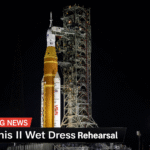
On January 17, 2026, NASA’s Space Launch System rocket and Orion spacecraft completed a painstaking journey to Launch Pad 39B at Kennedy Space Center in Florida. The 322-foot-tall rocket moved at just under one mile per hour across four miles of terrain, taking nearly 12 hours to reach its destination. This methodical rollout represents more than a logistical achievement—it signals America’s commitment to reclaiming its position as the leader in deep space exploration.
The Artemis II mission, scheduled to launch as early as February 6, 2026, will carry four astronauts on a 10-day journey around the Moon. This marks the first time humans will venture beyond low Earth orbit since the Apollo 17 mission in December 1972, over 50 years ago.
Background: The Artemis Program’s Economic Footprint
The Artemis program, formally established in 2017 through Space Policy Directive 1, has become one of the largest government-funded aerospace initiatives in recent history. According to NASA’s Office of Inspector General, the program’s total costs are projected to reach approximately $93 billion between 2012 and 2025.
The Space Launch System, developed by Boeing as the prime contractor, represents the most powerful rocket NASA has ever built. Lockheed Martin serves as the lead contractor for the Orion spacecraft, while Northrop Grumman and other major aerospace firms contribute critical components.
The program’s scale extends across the American economy. NASA reports that Artemis prime contractors currently work with more than 2,700 suppliers across 47 states, creating a substantial network of jobs and economic activity throughout the aerospace and defense sectors.
Key Mission Details and Technical Specifications
The Artemis II mission will carry NASA astronauts Reid Wiseman (commander), Victor Glover (pilot), and Christina Koch (mission specialist), along with Canadian Space Agency astronaut Jeremy Hansen. The crew will spend approximately 10 days in space on a free-return trajectory around the Moon.
The integrated rocket and spacecraft stack weighs 11 million pounds and traveled from the Vehicle Assembly Building aboard NASA’s upgraded crawler-transporter 2, a massive platform originally used during the Apollo and Space Shuttle programs.
Before launch, NASA will conduct a wet dress rehearsal in early February. This critical test involves loading all propellants into the rocket and running through standard launch-day procedures up to the final countdown moments. The rehearsal results will determine whether the mission stays on schedule for its February launch window.
Industry Perspectives and Contractor Involvement
“This one feels a lot different, putting crew on the rocket and taking the crew around the moon,” said John Honeycutt, a NASA official, on the eve of the rollout.
The mission represents significant business for major aerospace contractors. Lockheed Martin signed a $4.6 billion contract in 2019 to build six or more Orion capsules for the Artemis program. Boeing holds the prime contract for the Space Launch System’s development and production.
However, the contractor landscape faces uncertainty. Boeing informed its Space Launch System employees in February 2025 that they may face layoffs when current contracts expire, reflecting broader questions about the program’s long-term future.
Economic Impact and Cost Considerations
The Artemis program’s financial profile has drawn scrutiny from government oversight agencies. NASA’s Inspector General estimates that each Space Launch System launch costs approximately $4.2 billion for the first four Artemis missions—a figure that includes development, production, and operational expenses.
For comparison, the program spent over $40 billion from 2012 to 2020, with projected costs approaching $53 billion through 2025. These investments have generated substantial economic activity in the aerospace sector, supporting engineering, manufacturing, and technical positions across the country.
The aerospace and defense industry has responded positively to Artemis contracts. Lockheed Martin, with $64.7 billion in defense revenue, leads the sector. Boeing’s defense segment contributes $32.7 billion in annual revenue, though its commercial aerospace division has faced separate challenges.
Challenges and Budgetary Uncertainties
The Artemis program faces significant headwinds despite its technical progress. The Trump administration’s fiscal year 2026 budget proposal included a 24 percent reduction to NASA’s overall funding and called for canceling the Space Launch System and Orion spacecraft after the Artemis III mission.
The proposed budget suggests transitioning to commercial alternatives for future lunar missions, with potential savings of more than $3 billion annually. This shift would redirect funds toward commercial partnerships with companies like SpaceX while maintaining support for crewed missions to the Moon before China’s planned 2030 lunar landing.
Heat shield issues identified during the uncrewed Artemis I test flight in November 2022 required extensive engineering analysis and testing, contributing to mission delays. NASA engineers spent months investigating thermal performance and making design modifications to ensure crew safety.
Implications for Businesses and the Economy
The Artemis program’s future direction carries significant implications for the aerospace industry and broader economy. Traditional prime contractors like Boeing and Lockheed Martin face potential contract reductions if the government shifts toward commercial providers for transportation beyond Artemis III.
Conversely, commercial space companies could benefit from expanded opportunities. The proposed budget includes funding for commercial payload deliveries and human transportation system partnerships, potentially opening new revenue streams for private sector aerospace firms.
The program also drives technological innovation with spillover effects. Advanced materials, propulsion systems, and life support technologies developed for Artemis may find applications in commercial aviation, satellite systems, and other industries.
Employment patterns in the aerospace sector reflect these dynamics. Major defense contractors collectively employ hundreds of thousands of workers, with Lockheed Martin alone maintaining a workforce of approximately 121,000. Shifts in government contracting priorities directly impact these employment figures and the communities dependent on aerospace manufacturing.
Looking Ahead: Competition and Strategic Considerations
The Artemis program operates within a broader context of international space competition. China has announced plans to land astronauts on the Moon by 2030, adding geopolitical urgency to NASA’s timeline.
President Donald Trump has identified lunar exploration as a priority, though budget proposals suggest a preference for commercial solutions over traditional government-led approaches. This tension between maintaining American leadership and controlling costs will likely shape program decisions in coming years.
The February launch window represents a crucial test for Artemis stakeholders. A successful mission would validate the Space Launch System and Orion designs, strengthen the case for continued funding, and demonstrate America’s capacity for deep space exploration. Significant technical issues or delays could accelerate the shift toward commercial alternatives.

Conclusion
NASA’s Artemis II rocket rollout marks a tangible step toward returning humans to the Moon after more than 50 years. The mission carries substantial economic weight, supporting thousands of jobs across the aerospace sector and representing billions in government contracts.
The program faces a complex future balancing technical achievement, fiscal responsibility, and strategic competition. While the rocket now stands ready at its launch pad, questions remain about the long-term sustainability of current approaches versus emerging commercial alternatives.
For now, the aerospace industry watches closely as NASA prepares for its February fueling test and potential launch. The outcome will help determine not only the immediate mission’s success but also the broader trajectory of America’s space exploration efforts and the business landscape supporting them.
This article is for informational purposes only and does not constitute investment advice. Readers should conduct their own research and consult with financial professionals before making investment decisions.