INTRODUCTION
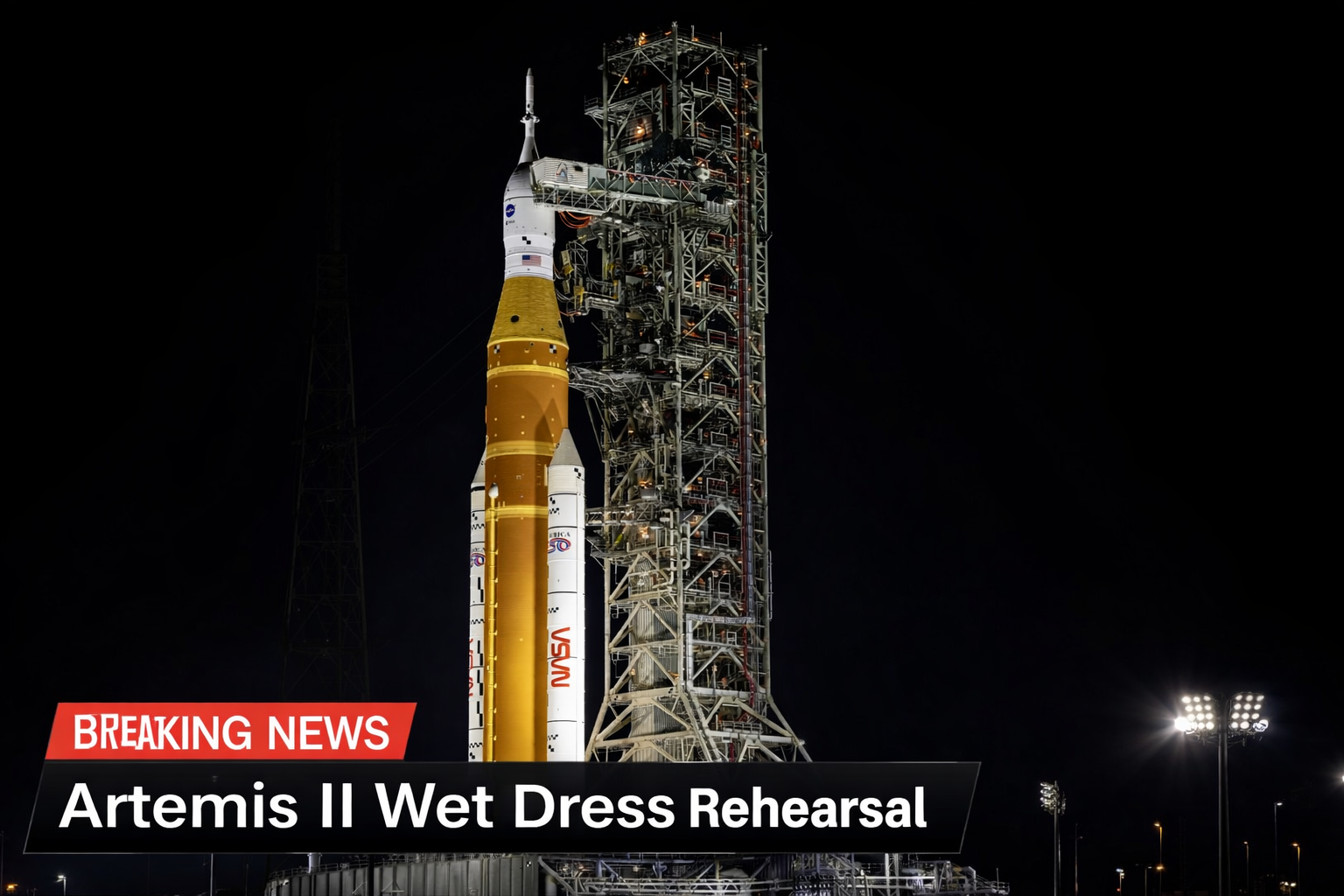
The Artemis II Wet Dress Rehearsal has once again placed NASA’s ambitious Moon programme at the centre of global attention. Conducted at Launch Complex 39B at the Kennedy Space Center in Florida, the rehearsal was meant to be a decisive step before astronauts board the Artemis II mission. However, the countdown was terminated just minutes before a critical milestone after engineers detected a liquid hydrogen leak
The development is trending worldwide, including in India, because Artemis II is not just another rocket test. It represents humanity’s return to crewed lunar missions after more than five decades and sets the stage for long-term Moon exploration. For India which is rapidly expanding its space ambitions through ISRO developments in the Artemis programme carry strategic, technological, and collaborative significance
What Is Happening
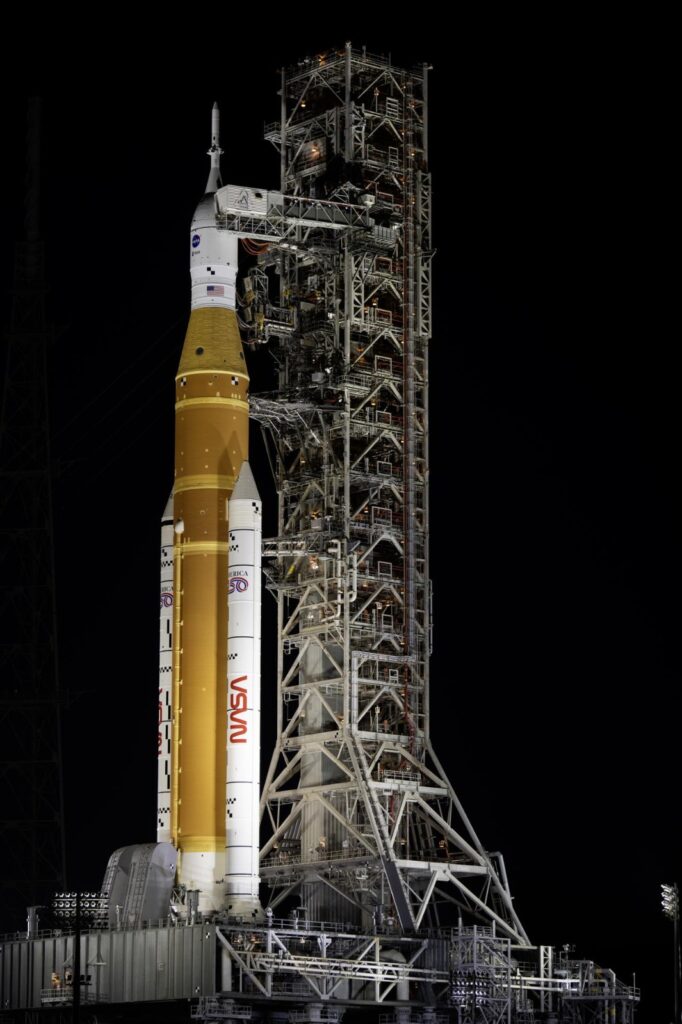
The Artemis II Wet Dress Rehearsal is a full-scale launch simulation designed to test the Space Launch System rocket, the Orion crew capsule, and ground systems under real launch-day conditions. During the latest attempt, NASA teams loaded cryogenic liquid oxygen and liquid hydrogen into the rocket, replicating the exact process that would be followed on launch day
According to official NASA updates, the countdown was halted at approximately T-minus 5 minutes after sensors detected a hydrogen leak at the interface of the tail service mast umbilical. This component supplies fuel and power to the rocket while it remains on the launch pad
NASA confirmed that the launch control team placed the vehicle in a safe configuration and began detailed inspections. Wet Dress Rehearsals are intentionally designed to expose such issues, allowing engineers to fix them well before astronauts are onboard
This rehearsal is especially significant because Artemis II will be the first crewed mission of the Artemis programme carrying astronauts on a lunar flyby Any anomaly even during testing, is treated with extreme caution
Key Data and Statistics
| Component | Details |
|---|---|
| Rocket | Space Launch System Block 1 |
| Spacecraft | Orion crew capsule |
| Launch Site | Launch Complex 39B, Kennedy Space Center |
| Countdown Halt | Around T-minus 5 minutes |
| Issue Detected | Liquid hydrogen leak |
| Mission Type | Crewed lunar flyby |
| Target Year | Mid to late 2026 |
The data highlights why the Artemis II Wet Dress Rehearsal is so critical. Unlike Artemis I, which flew without astronauts, Artemis II places human lives at the forefront of every engineering decision
Liquid hydrogen, while efficient, is notoriously difficult to handle due to its extreme cold and tendency to leak through microscopic gaps. Historically hydrogen-related delays have affected multiple space programmes including NASA’s Space Shuttle era
Why This Matters for India
For Indian readers, the Artemis II Wet Dress Rehearsal may seem geographically distant, but its implications are closer to home than they appear
India’s space sector is undergoing a rapid transformation. ISRO’s Chandrayaan missions have elevated India’s standing in lunar science, while private startups are increasingly entering the space ecosystem. NASA’s Artemis programme sets benchmarks in human spaceflight safety, heavy-lift rocket engineering, and deep-space mission planning
India is also part of the broader international conversation around lunar governance, resource utilisation, and space sustainability. Lessons learned from Artemis II will influence future global standards, including those India may adopt or adapt
Additionally, collaboration between NASA and ISRO has been steadily growing, particularly in Earth observation and astronaut training. Developments in Artemis missions indirectly shape India’s long-term human spaceflight roadmap, including the Gaganyaan programme
Industry and Expert Perspective
From an industry standpoint, the pause during the Artemis II Wet Dress Rehearsal is not viewed as a failure. Aerospace experts consistently emphasise that wet dress rehearsals are meant to uncover weaknesses under realistic conditions
NASA itself has stated in multiple briefings that safety, not speed, defines the Artemis timeline. The agency’s approach reflects hard-earned lessons from past tragedies, reinforcing why testing phases are deliberately conservative
Industry analysts note that hydrogen leaks are among the most challenging technical hurdles in heavy-lift rockets. Addressing them early prevents far more serious risks during actual launch attempts
The global space industry, including commercial players and national agencies, closely watches Artemis milestones. The programme’s success or delay influences supply chains, technology transfer, and even investor confidence in space-related ventures
Challenges and Risks
Despite its promise, the Artemis II mission faces several challenges
The Space Launch System is one of the most powerful rockets ever built, but it is also complex and costly. Each delay increases operational expenses and puts pressure on long-term schedules
Hydrogen fuel management remains a recurring challenge. Even minor leaks require extensive inspections, component replacements, and re-certification processes
There is also the broader challenge of public expectations. High-profile missions generate intense media attention, and delays can sometimes be misinterpreted as setbacks rather than safety-driven decisions
For NASA, balancing transparency, technical accuracy, and public confidence is an ongoing task during the Artemis II Wet Dress Rehearsal phase
What Happens Next
Following the halted countdown, NASA engineers will conduct a thorough review of data collected during the rehearsal. This includes inspecting seals, valves, and sensors associated with the tail service mast umbilical
Once repairs are completed, NASA may schedule another Wet Dress Rehearsal or proceed with targeted testing, depending on the findings. Only after all systems meet safety and performance criteria will the Artemis II mission move closer to an official launch date
In the long term, Artemis II is a stepping stone toward Artemis III, which aims to land astronauts on the Moon’s surface. Each test, delay, and correction contributes to building confidence in the programme’s overall reliability
FAQs
What is the Artemis II Wet Dress Rehearsal
It is a full launch-day simulation where NASA fuels the rocket and runs the countdown without liftoff to test systems and procedures
Why was the Artemis II rehearsal stopped
The countdown was halted due to a liquid hydrogen leak detected near a ground support interface
Does this delay the Artemis II mission
Minor delays are possible, but such pauses are normal and focused on safety rather than schedule pressure
Is Artemis II a Moon landing mission
No, Artemis II is a crewed lunar flyby mission that prepares for future Moon landings
Why should India care about Artemis II
The mission shapes global space standards and influences India’s own lunar and human spaceflight ambitions
CONCLUSION
The Artemis II Wet Dress Rehearsal may not have ended with a flawless countdown, but it achieved its core purpose by identifying a critical issue before astronauts are involved In space exploration caution is progress, and every halted test strengthens future missions
As NASA works through technical challenges, Artemis II continues to symbolise humanity’s return to deep-space exploration. For India and the world, the mission underscores how modern spaceflight is built on patience, data, and international learning rather than speed alone